Your company's YA 2026 Corporate Income Tax Return is due on Monday, 30 November 2026 — five days from 25 November 2026. If corporate tax payment in Singapore is on your list this week, filing and paying fall on different dates.
Year of Assessment (YA) is not the same as financial year. YA 2026 is the year IRAS assesses income from your company's 2025 financial year (FY2025). The return must be filed by 30 November 2026. You pay later, within one month of your Notice of Assessment (NOA). YA 2027 is a later return, for the 2026 financial year, and is not the deadline this post covers.
This is general information, not tax advice. Check with your tax adviser.
Five days left: what to do this week
Do this now
Confirm which form applies (see the table below) and file at mytax.iras.gov.sg by 30 November, unless IRAS has granted a waiver. Companies that made a loss or did not carry on business in FY2025 still file, unless a waiver applies. Whoever files — an employee or your tax agent — needs Corppass Approver authorisation for the "Corporate Tax (Filing and Application)" digital service (go.gov.sg/corppassauth). Directors remain responsible for timely, accurate filing even when a tax agent is engaged. Late filing or non-filing may lead to penalties of up to S$5,000. One narrow exception: Form C-S filed through accounting software (#SeamlessFilingFromSoftware, or #SFFS) gets an automatic 15-day extension to 15 December, for YA 2023 to YA 2027. Form C, Form C-S or Form C-S (Lite) filed through myTax Portal is still due 30 November.
If you miss 30 November
Not filing by the due date is an offence. IRAS may issue an estimated NOA (still payable within one month, even if you object), offer to compound the offence for up to S$5,000 (GIRO cannot be used to pay this), issue a Section 65B(3) notice to a director, or issue a Notice to Attend Court or summons to the company or the people responsible, including directors.
On conviction, the company may be fined up to S$5,000 per offence. A director who fails to comply with a Section 65B(3) notice and is convicted could face a fine of up to S$10,000, up to 12 months in prison, or both, per offence. If returns are unfiled for two or more years, a convicted company may be ordered to pay a penalty of twice the tax assessed and a fine of up to S$5,000, for each offence. Outstanding returns must still be filed at myTax Portal. For the current YA, you can request more time through "Request Extension of Time to File", but only after 30 November, and not once a summons has been issued. IRAS does not grant filing extensions for previous YAs.
Who must file, and which form
Every company must file unless IRAS has granted a waiver. The headline tax rate remains a flat 17% of chargeable income.
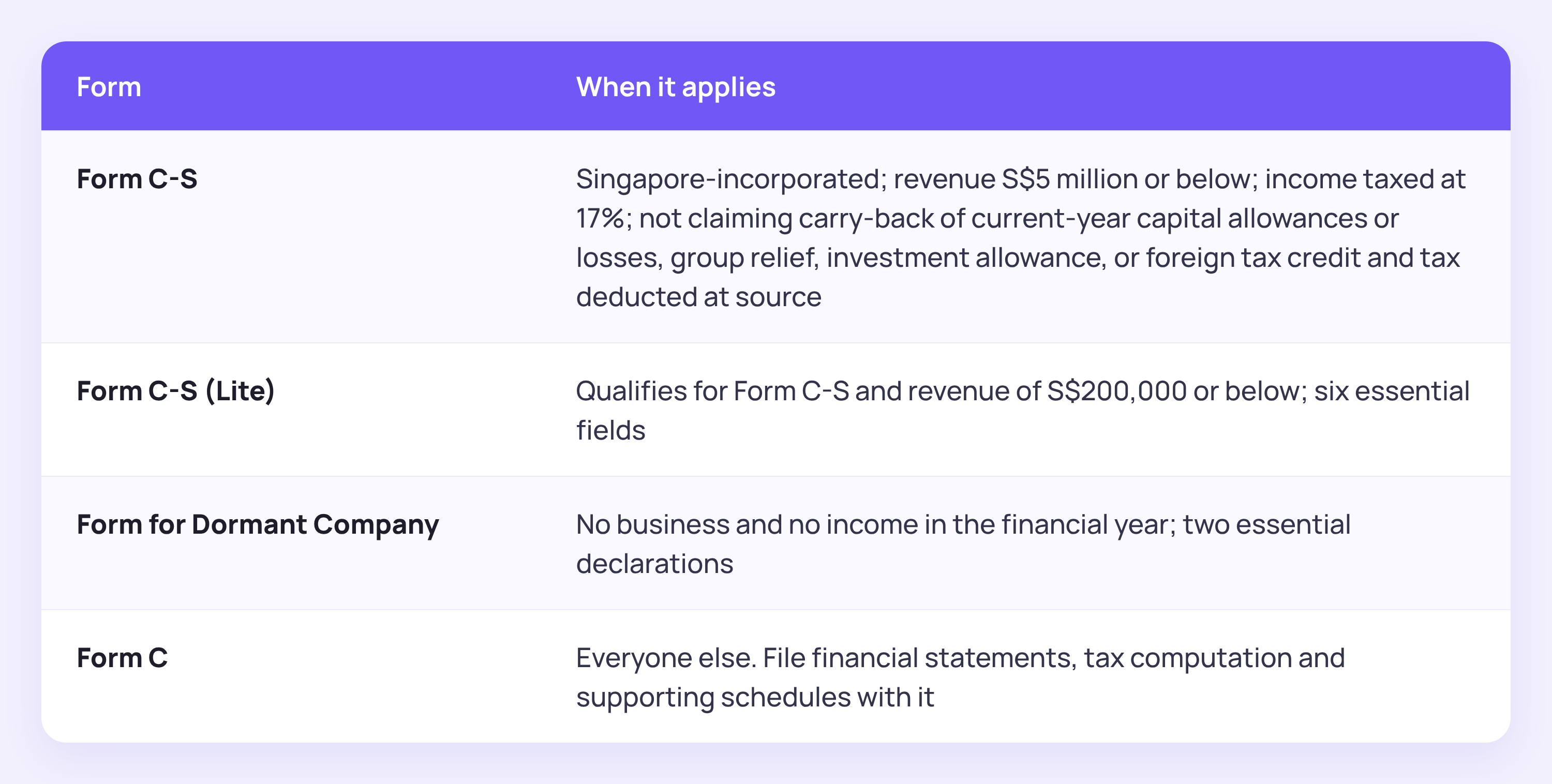
Incorporated in 2025: file a YA 2026 return if the company closed its first accounts in 2025 and derived income or started business that year. If it did not close its first accounts in 2025, or closed them without commencing business or receiving income, there is no YA 2026 filing.
Made a loss: you still file if the company carried on business or received income in FY2025.
Dormant: check "Update Corporate Profile" on myTax Portal. "No Business Done" means a waiver has been granted. "Active" means file the Form for Dormant Company. If business has restarted but the status is unchanged, submit the Recommencement of Business form to request the return.
Filing vs paying: how corporate tax payment works in Singapore
Tax is payable within one month of the NOA date, even if you have filed a revision or objection. To revise or object, use the Revise/Object to Assessment digital service on myTax Portal within two months of the NOA date. Pay by GIRO (preferred), PayNow QR, AXS or internet banking. Tax credits are refunded automatically by GIRO or PayNow Corporate within 30 days of the date the credit arose; you do not need to claim a refund.
GIRO instalments depend on how promptly you e-file your first Estimated Chargeable Income (ECI):
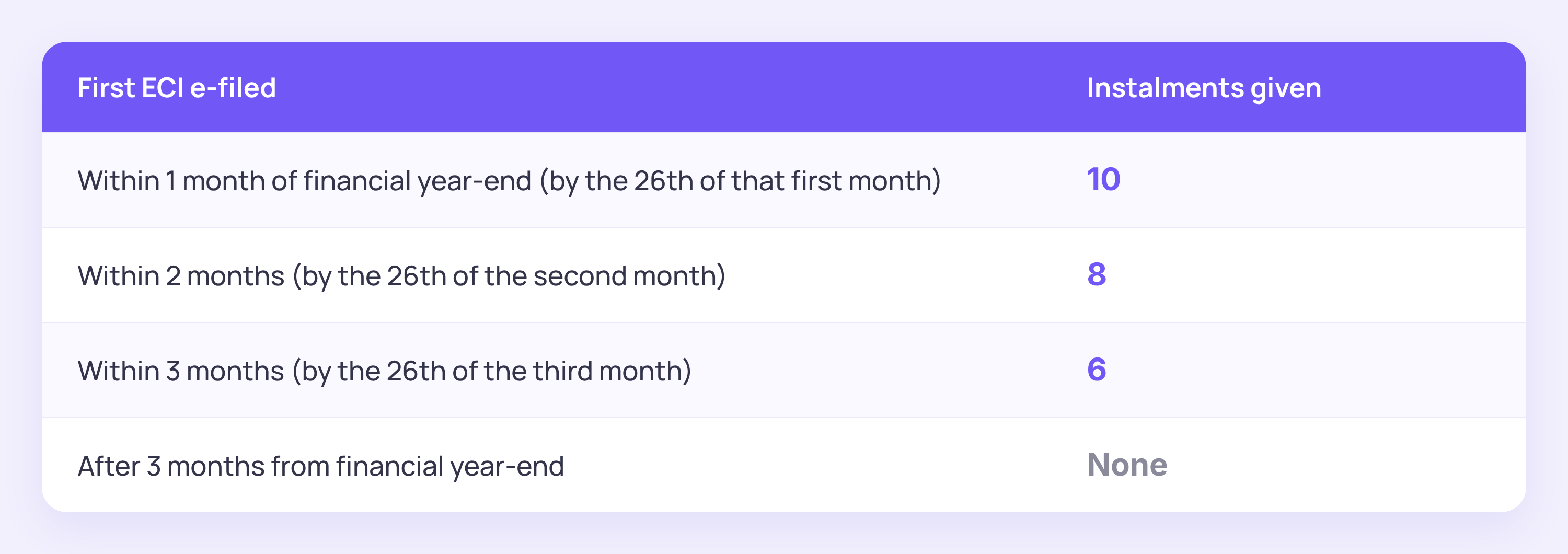
Deductions are on the 6th of each month, with a retry on the 20th; the arrangement is cancelled if both fail. The minimum monthly deduction is S$50. Only companies registered in Singapore are eligible, and back years' taxes cannot be paid in instalments. GIRO must be approved before the payment due date to avoid late-payment penalties (typically the next working day to reactivate, 3 working days for a new online application, or 3 weeks for a hardcopy form).
If full payment is not received by the due date, IRAS imposes a 5% penalty on the unpaid tax. If the tax is still unpaid 60 days after that 5% penalty is imposed, an additional 1% for each completed month may apply, capped at 12% of the unpaid tax. That 12% cap is on the additional monthly penalty only, not on the 5% and the monthly penalty combined. IRAS may appoint agents, such as a bank, tenant or lawyer, to recover overdue tax, and may take legal action. Directors remain responsible for filing and payment even if a tax agent has been appointed.
What changed this year vs last year: the CIT Rebate
After the 7 April 2026 enhancement, the headline YA 2026 rebate terms are the same as YA 2025. The rebate rate itself did not go up versus last year. Budget 2026 first announced a smaller package; the First Support Package on 7 April 2026, responding to energy-cost pressures from the Middle East situation, restored it to last year's levels. A new, separate SME Cash Grant 2026 followed on 29 July 2026.
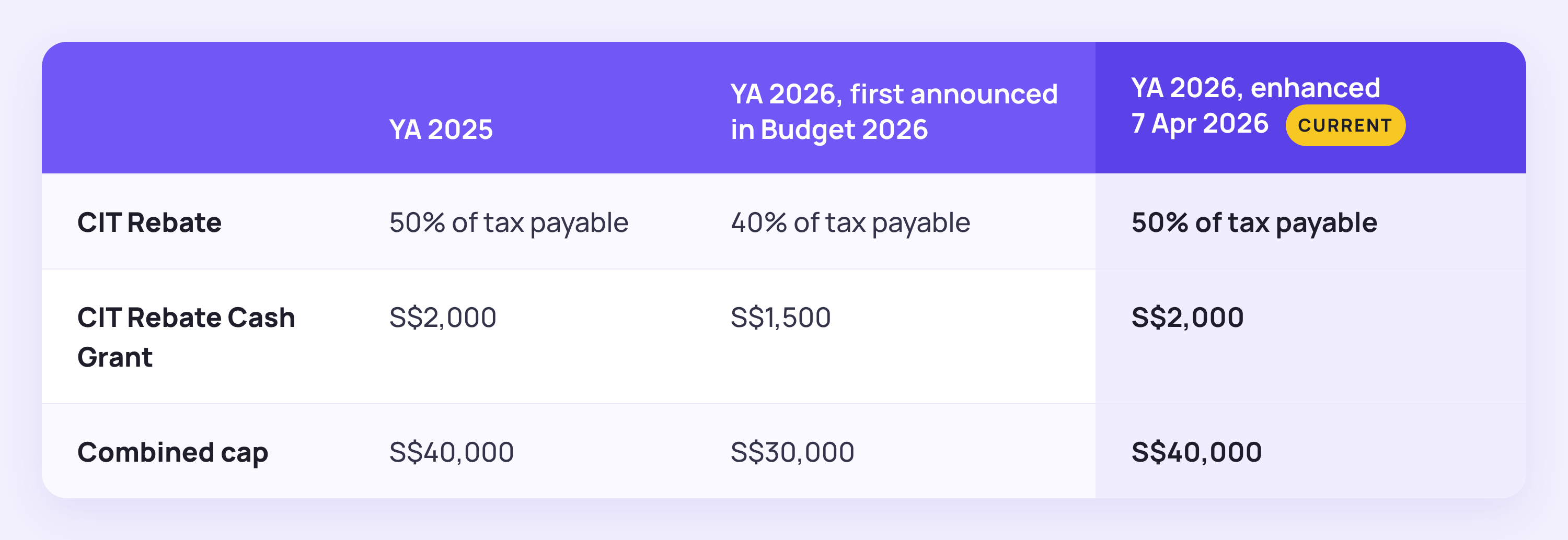
Source: IRAS Corporate Income Tax Rates and gov.sg/budget2026. The YA 2026 cash grant uses the local-employee test for calendar year 2025.
CIT Rebate vs SME Cash Grant 2026: two different things
Eligible companies receive a 50% CIT Rebate of corporate tax payable. Active companies that made CPF contributions in calendar year 2025 for at least one local employee (Singapore citizen or PR) also receive a S$2,000 CIT Rebate Cash Grant. Shareholders who are also directors do not count as that employee. The grant is not taxable and was to be paid automatically by the second quarter of 2026, so eligible companies should already have received it. Rebate and cash grant together are capped at S$40,000.
If you are eligible for the cash grant and the computed rebate is S$2,000 or less, no further CIT Rebate is given; if it is more than S$2,000, you receive the rebate (capped at S$40,000) minus S$2,000. If you are not eligible, any rebate above S$0 is given, capped at S$40,000. Leave the rebate out of your ECI and Form C, C-S or C-S (Lite) — IRAS computes it automatically. This is not a minimum S$2,000 for every company.
The SME Cash Grant 2026 is separate. Eligible businesses receive S$500 per local qualifying employee, up to S$2,500, based on the highest monthly headcount from April to June 2026, with timely CPF contributions. Payouts started from 2 November 2026. No application is required. Shareholder-directors do count here. A Pte. Ltd. with no local qualifying employees does not qualify. (A flat S$500 for businesses with no local employees applies only to sole proprietorships and partnerships run by at least one local owner, with net trade income of S$100,000 or less for YA 2025, declared and assessed by 31 August 2026.)
It covers active, ACRA-registered companies, sole proprietorships and partnerships (including LLPs) with YA 2025 revenue of no more than S$100 million (filed and assessed by IRAS as at 31 August 2026), or no more than 200 employees as at 30 June 2026, and that were still active at disbursement in November 2026. Payment is by GIRO (in place as at 14 October 2026) or PayNow Corporate (registered as at 25 October 2026); there are no cheques. If you believe you were eligible but did not receive it, use the official eligibility checker first, then appeal between 2 November 2026 and 7 January 2027. Later appeals will not be considered.
Looking ahead: your ECI date
ECI is due within three months of your financial year-end, unless you qualify for the waiver or are specifically not required to file. The waiver applies only if both are true: annual revenue of S$5 million or below, and nil ECI for the YA, measured before partial tax exemption or the start-up tax exemption. You self-assess; there is no need to inform IRAS, even if myTax still shows "Ready to File".
A 30 September 2026 year-end has ECI due 31 December 2026. A 31 December 2026 year-end has ECI due 31 March 2027. Filing earlier can mean more GIRO instalments. Late or failed ECI filing can lead to an estimated NOA, payable in full within one month, with no instalments.
If the tax bill squeezes cash flow
Start with IRAS's own options: GIRO instalments, if you still qualify, or a longer payment plan through "Apply/Manage GIRO Plan" on myTax Portal.
If you also want to compare working-capital options, SmartLend is a platform for comparing lender offers, not the lender. Lenders decide whether to approve an application and on what terms. DIY has a S$0 SmartLend platform fee, but lender fees and interest still apply.
FAQ
Is 30 November the deadline to pay my corporate tax? No. It is the filing deadline. Payment is due within one month of the NOA date, even if you revise or object.
My company made a loss or was quiet in FY2025. Do we still file? Yes, if it carried on business or received income. If it was dormant, check myTax: "No Business Done" means a waiver; "Active" means file the Form for Dormant Company.
Can we have until 15 December? Only for Form C-S filed through #SFFS accounting software. myTax Portal filing is still due 30 November. A current-YA extension request can be made only after 30 November, and not once a summons has been issued.
Do I need to claim the CIT Rebate on Form C-S? No. Leave it out of the ECI and the return. IRAS computes it in the assessment.
Our only staff are shareholder-directors. Do we get either cash grant? The CIT Rebate Cash Grant does not count shareholder-directors. The SME Cash Grant 2026 does, if timely CPF contributions were made and the other tests are met. Check the official IRAS eligibility checker.
This is general information, not tax or legal advice. Check with your tax adviser before acting. Figures and dates are from official IRAS, MOF and GOV.sg pages as of 25 November 2026 and may change.
Source:
gov.sghttps://www.mof.gov.sg/news-resources/newsroom/press-conference-on-second-support-package-in-response-to-the-continuing-middle-east-situation/https://www.iras.gov.sg/schemes/disbursement-schemes/SME-Cash-Grant-2026https://www.gov.sg/budget2026/https://www.iras.gov.sg/docs/default-source/media-releases/ct-release/annex-b---support-measures-for-companies.pdfhttps://www.iras.gov.sg/taxes/corporate-income-tax/estimated-chargeable-income-(eci)-filinghttps://www.iras.gov.sg/taxes/corporate-income-tax/form-c-s-form-c-s-(lite)-form-c-filing/late-filing-or-non-filing-of-Corporate-Income-Tax-Returns-form-c-s-form-c-s-(Lite)-form-chttps://www.iras.gov.sg/taxes/corporate-income-tax/corporate-income-tax-payment/late-payment-or-non-payment-of-corporate-income-taxhttps://www.iras.gov.sg/quick-links/payments/giro-corporate-income-taxhttps://www.iras.gov.sg/digital-collaboration/for-businesses-employershttps://www.iras.gov.sg/taxes/corporate-income-tax/form-c-s-form-c-s-(lite)-form-c-filing/using-accounting-software-to-prepare-file-form-c-s-seamlesslyhttps://www.iras.gov.sg/quick-links/tax-rates/corporate-income-tax-rateshttps://go.gov.sg/corppassauthhttps://www.iras.gov.sg/due-dateshttps://www.iras.gov.sg/who-we-are/what-we-do/annual-reports-and-publications/taxbytes-iras/companies-self-employed-partnerships/3-things-to-know-for-corporate-income-tax-filing-2026https://www.iras.gov.sg/taxes/corporate-income-tax/basics-of-corporate-income-tax/corporate-income-tax-filing-season-2026