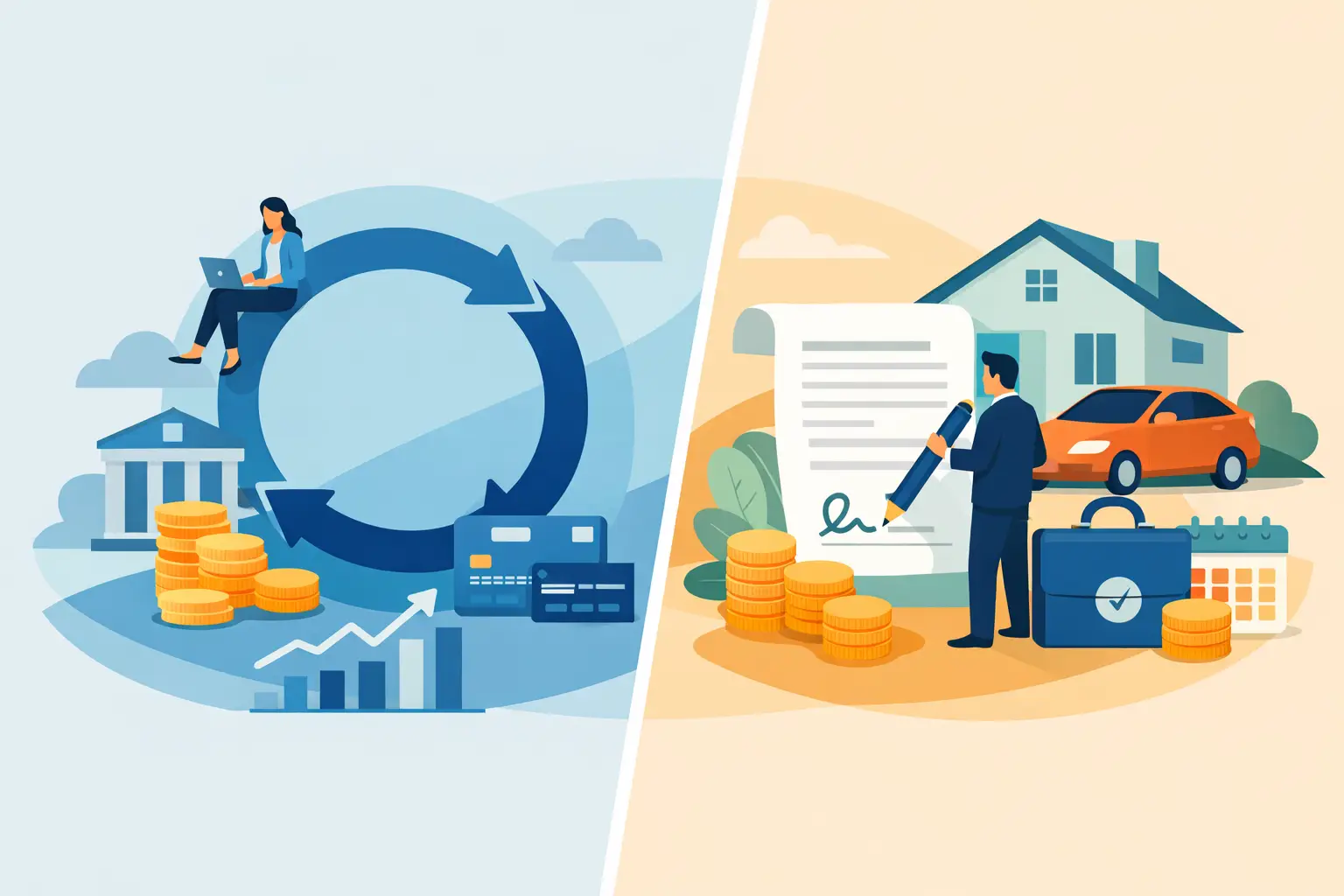
A late-paying customer, a stock purchase opportunity and next month’s payroll can create very different funding needs. The choice between revolving credit versus term loan is not simply about which facility offers the lower headline rate. It is about matching the repayment structure to the reason you need capital, so borrowing supports cash flow rather than adding avoidable pressure.
For many SMEs, the right answer may be one facility, a combination of both, or neither until the business has a clearer plan for using and repaying the funds. The key is to compare the full commercial picture: access to cash, interest, fees, tenure, repayment obligations and lender conditions.
What is revolving credit?
Revolving credit is a pre-approved borrowing facility with a set limit. Your business can draw funds when required, repay some or all of the balance, then draw again, provided the facility remains active and you stay within the agreed limit.
Think of it as funding capacity kept available for short-term needs. If you have a S$100,000 revolving facility and use S$30,000 to cover a temporary cash gap, interest is generally charged on the S$30,000 used, not the full limit. Once a customer payment arrives, you can repay the amount and restore your available credit.
This flexibility makes revolving credit useful when the timing and amount of funding are uncertain. It can help bridge slow receivables, manage seasonal inventory purchases or cover routine operating costs while revenue catches up.
The trade-off is that flexibility may come with a higher interest rate than a secured term loan, alongside annual review fees, commitment fees or other facility charges. Lenders may also review the line regularly, alter conditions at renewal, or require repayment if there is a breach of the facility agreement.
When revolving credit fits
Revolving credit is usually best for short-lived, repeating funding requirements. A distributor that pays suppliers before its customers settle invoices may need to draw and repay funds several times a year. A retailer may need extra purchasing power ahead of a busy trading period, then repay the balance after sales are collected.
It is less suitable for a large, one-off purchase that will take years to generate returns. Using short-term, callable credit to finance long-lived equipment can leave the business exposed if the facility is reduced or not renewed before the asset has paid for itself.
What is a term loan?
A term loan provides a fixed amount of capital that is repaid over an agreed period. The business normally receives the funds upfront and makes scheduled repayments, often monthly, covering principal and interest.
This structure gives owners more certainty. You know the repayment timetable from the start, which makes it easier to build the commitment into cash-flow forecasts. Depending on the lender and product, the interest rate may be fixed or variable, and the loan may be secured against business or personal assets.
Term loans are commonly used for defined investments with a clear purpose and a longer expected benefit. Examples include buying machinery, fitting out a new premises, acquiring stock for a confirmed expansion, investing in technology, or funding a business acquisition.
The discipline of fixed repayments is both a benefit and a constraint. A term loan reduces the temptation to keep reusing credit for everyday shortfalls, but repayments continue even if sales are temporarily weaker. Some lenders also charge fees for early settlement, so check whether the business expects to repay ahead of schedule.
When a term loan fits
A term loan is generally a stronger match when you know how much you need, what it will be used for and how long the investment should contribute to revenue. If a production machine has a five-year working life, a multi-year repayment plan can align more sensibly with the value it creates.
The same logic applies to an expansion with a realistic forecast. Borrowing a known sum to open a second outlet or build out a service team may be easier to manage through predictable instalments than through a revolving facility that needs periodic renewal.
Revolving credit versus term loan: the practical differences
The main difference is not whether one is “good” and the other is “bad”. It is how each facility behaves once funds are available.
With revolving credit, the limit is reusable. Interest normally applies to the outstanding balance, and repayments can be made as cash becomes available. This supports flexibility, but requires strong controls. If the balance remains permanently drawn, the facility is no longer solving a temporary gap. It may be masking an underlying working-capital problem.
With a term loan, the amount is drawn once and paid down to zero over the agreed tenure. The repayment schedule creates clarity and may support longer-term planning, though it also reduces room to adjust during leaner months.
Cost comparisons require more than a glance at the advertised interest rate. Review the effective cost after considering processing fees, annual facility fees, legal charges, late-payment charges, commitment fees and any early repayment costs. A lower rate does not always mean a lower overall cost if the facility has substantial fees or forces the business to borrow more than it actually needs.
Security matters too. Depending on the product and borrower profile, a lender may ask for a personal guarantee, corporate guarantee, fixed or floating charges, property security or specific asset security. Read the terms carefully and understand what is at risk if the business cannot meet its obligations.
Choose based on the cash conversion cycle
The most useful question is: when will the money return to the business?
If you spend S$50,000 on inventory in April, sell it by June and collect customer payments in July, a revolving facility may suit the short cycle. You can draw for the purchase and repay when collections arrive. The facility can then be reused for the next cycle rather than replaced with a new loan application.
If you spend S$50,000 on equipment that produces income over several years, a term loan may be the more balanced option. The business should not need to generate the entire repayment amount within a few months, because the asset itself will support revenue over a longer period.
This matching principle helps avoid a common mistake: financing a long-term investment with short-term debt, or using a long-term loan for a brief cash-flow gap. Neither choice is automatically wrong, but both can create unnecessary cost or repayment strain.
Questions to ask before you compare offers
Before approaching lenders, be clear on the funding purpose, amount required and repayment source. A lender will look more favourably on a well-supported request than a vague need for “working capital”. Prepare recent financial statements, management accounts, bank statements, debtor ageing reports and details of existing borrowings where available.
You should also test affordability under a conservative scenario. Ask whether the business can still meet repayments if a major customer pays late, sales fall for two months or costs rise. Facilities should give the business room to operate, not consume every spare dollar of monthly cash flow.
When comparing options, look beyond approval speed. Check the approved limit or loan amount, interest calculation method, tenure, repayment frequency, collateral requirements, renewal terms and events that could trigger a demand for repayment. Fast approval is valuable, but only when the terms remain suitable after funds are received.
For Singapore businesses comparing several lenders, a centralised comparison process can reduce repeated research and make differences in rates, terms and approval requirements easier to assess. Smart-Lend helps businesses review relevant financing options with greater clarity before making that commitment.
Can a business use both?
Yes. A growing business may use a term loan for a planned capital purchase and retain revolving credit for routine working-capital fluctuations. This can separate long-term investment from day-to-day cash management, giving each borrowing facility a clear role.
However, using both increases total debt exposure. The combined repayments, interest and fees must still fit the business’s cash flow. Keep a clear view of all facilities rather than assessing each one in isolation.
The strongest borrowing decision starts with the life of the need, not the availability of the money. Choose revolving credit when you need reusable capacity for temporary gaps; choose a term loan when you are funding a defined investment over time. Then compare the full terms carefully, because the right facility is the one your business can use confidently and repay without sacrificing its next opportunity.