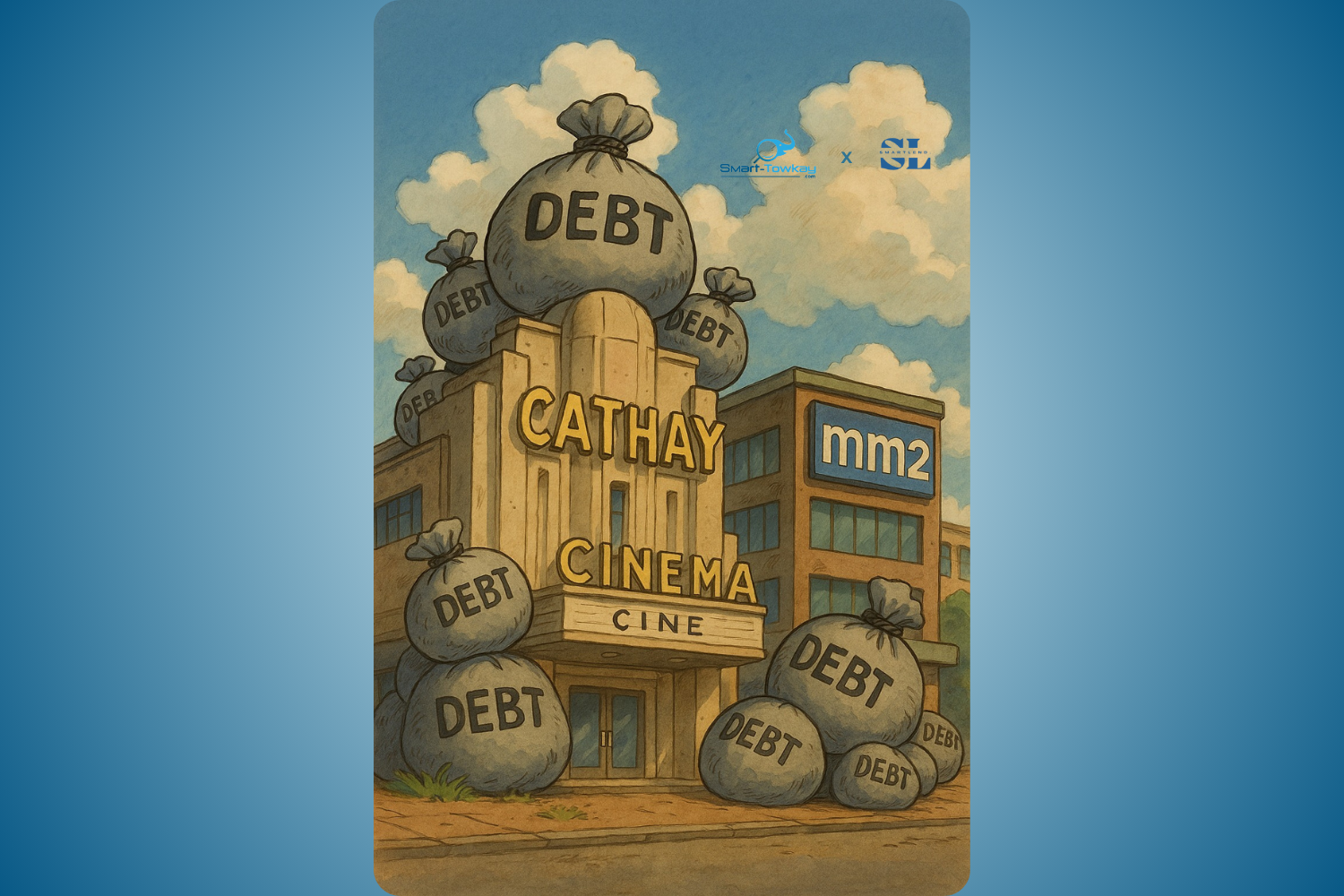
What went wrong when content kings became cinema landlords?
By SmartLend Editorial
⚡ TL;DR
mm2 Asia – once a rising star in film production – shot to prominence with box-office hits and bold acquisitions, including paying S$230 million for Cathay Cineplexes in 2017. But overexpansion, especially into the capital-intensive cinema business, left it overleveraged when COVID-19 struck. The pandemic shuttered theaters and gutted revenue, sending mm2 into steep losses and forcing multiple debt restructurings. Its stock, which was riding high in the late 2010s, has since plunged into penny-stock territory (from all time high of S$0.427 on Jun 2017 to all time low of S$0.004 on July 2025).
After numerous rescue attempts – rights issues, asset sales, merger talks – mm2 Asia now faces a last-ditch
Founder Origin Story
Founder: Melvin Ang
Background: A former TV executive turned film producer.
After stints at TCS and Mediacorp, Ang founded mm2 Asia in 2008, aiming to create and finance Asian content. With savvy marketing and local appeal, mm2 produced a string of hit Singapore films (e.g. Jack Neo’s Ah Boys to Men series). The company quickly expanded regionally and vertically: by 2014 it became the first local production house to list on SGX Catalist, and by 2017 it had uplisted to the Mainboard and acquired concert promoter UnUsUaL and 3D animation studio Vividthree. At its peak, mm2 Asia had offices across Asia and a diversified media empire spanning film production, post-production, talent management and live events.
💡 At the time, mm2’s strategy was to build an “ecosystem” – from creating movies to distributing them via its own theaters. The crown jewel of this vision was Cathay Cineplexes, a storied Singapore cinema chain.
The Problem
Overexpansion + Debt + Pandemic
mm2’s aggressive growth was built on debt-fueled acquisitions. The Cathay buyout alone added significant leverage – financed in part by bank loans, a vendor note, and convertible bonds. This might have been manageable under normal conditions, but the timing was disastrous.
In 2020, COVID-19 forced cinemas to close for months. Even when theaters reopened with capacity caps, moviegoers stayed home, accelerating the shift to streaming. mm2’s cinema revenues evaporated, and from Jan–Jun 2020 it swung to a net loss of S$22.4 million (versus a S$9.2 m profit in the same period of 2019). The company’s overheads – rents, staff, interest on loans – didn’t shrink accordingly.
By March 2021, mm2’s liabilities exceeded its assets by about US$119.5 million, prompting auditor warnings about its viability.
💡 In short, what was meant to be a steady cash cow (the cinema business) turned into a cash drain. The once-profitable content production arm could not prop up a collapsing exhibition arm, especially as film releases stalled and consumer habits changed.
The High-Stakes Bet That Backfired
In hindsight, mm2’s 2017 cinema gamble looks like a classic overreach. It paid S$230 million to acquire Cathay Cineplexes’ eight Singapore locations, outbidding others in a bid to lock in a “steady revenue stream”. Flush from its successful Catalist IPO, mm2 was eager to dominate the big screen: earlier that year it even tried to buy a stake in rival Golden Village for S$184 million, but lost out to another bidder. Undeterred, founder Melvin Ang believed owning cinemas would vertically integrate the business – providing guaranteed venues for mm2’s films and a buffer of stable income to balance the hit-driven nature of content production.
What Went Wrong?
The strategy might have worked if not for external upheavals. Cathay’s performance was initially decent, but no one foresaw a pandemic obliterating the cinema industry. mm2 suddenly found itself servicing huge loans on an asset that couldn’t operate for long stretches. By 2021, Cathay Cineplexes had become a millstone, with attendance still far below pre-COVID levels and no blockbuster releases in the pipeline (Hollywood’s 2023 writers’ and actors’ strikes further thinned content supply).
The Merger That Never Was: Golden Village Alliance
Desperate to save the sinking ship, mm2 Asia explored merging its Cathay cinemas with Golden Village (Singapore’s largest chain) in 2020. The idea was to gain synergies – combine operations, cut costs, and bring in new investors to recapitalize the merged entity.
Regulators and shareholders, however, were not on board.
The plan encountered multiple hurdles (competition concerns, approvals) and ultimately fell through. This left mm2 back at square one: holding an ailing cinema business alone, with no white knight in sight.
The Failed Exit: Kingsmead Sale Falls Through
When the merger hopes faded, mm2 pivoted to an outright sale. In August 2021, it announced a deal to sell its entire cinema business (under subsidiary mm Connect) to local investor Kingsmead Properties for S$84.8 million. The price was barely 37% of what mm2 had paid four years prior – a testament to how far Cathay’s value had fallen – but those funds were critical to pay down loans and a convertible bond coming due on Dec 31, 2021. Kingsmead put up a S$6 million deposit, and things looked set for completion by end-2021. Then came another twist: the Omicron variant hit.
Fresh pandemic uncertainty spooked the buyer, and by early 2022 the deal was off. Rather than pull out entirely, Kingsmead exercised an option to convert its deposit into equity – taking 75 million new mm2 shares at S$0.08 each.
This one-off share issuance gave mm2 a bit of cash relief and a new minority stakeholder, but no transfer of the cinema liabilities. The Cathay cinemas were still mm2’s problem – only now time was almost up to find another solution.
The Domino Effect
The collapse of these savior deals sent shockwaves through mm2’s business:
- No Cash Infusion: Without the Golden Village merger or the Kingsmead sale, mm2 was unable to significantly deleverage. A planned rights issue in early 2021 had raised ~S$54 million (mostly used to pay off an earlier bond due April 2021), but the much larger debt pile remained. The crucial S$47.85 million convertible bond tied to the cinema unit had to be extended again past 2021. (By 2025, mm2 would seek to push this bond’s maturity all the way to 2031 to avoid default.)
- Investor Confidence Shattered: mm2’s stock, once a market darling above 40¢, went into freefall. As hopes for a turnaround dimmed, its market capitalization shrank from about S$175 million in late 2020 to just S$32–33 million by mid-2025. In other words, over 80–90% of shareholder value evaporated. What had been a billion-dollar vision of a pan-Asian media empire was now trading for mere pennies, reflecting the market’s grim outlook.
- Operational Cutbacks: With mounting losses, mm2 had to triage its cinema operations. It began shuttering outlets to stem the bleeding. In 2022, Cathay’s flagship Handy Road cinema (in The Cathay building) closed. In 2023, two more – Cineleisure Orchard and Parkway Parade – were shut. 2024 saw the AMK Hub cineplex exit as well. By mid-2025, six Cathay cinemas had closed in three years, leaving only four locations still operating (Causeway Point, Century Square, Downtown East and 321 Clementi). Each closure saved costs but also shrank revenue potential and market presence, a sign of retrenchment from mm2’s once-grand expansion.
- Creditors at the Door: The remaining cinemas continued to struggle, and unpaid bills piled up. Landlords who had given concessions during COVID started demanding arrears. In January 2025, mm2 disclosed that it received letters of demand for S$2.7 million in owed rent and expenses for Cathay Cineplexes. The company missed a Feb 10, 2025 deadline to settle that sum, seeking to negotiate a payment plan. By mid-2025, demands escalated – Cathay’s West Mall and JEM landlords were seeking S$3.45 million in back rent, with one setting a hard deadline of Jul 22. Then came a potentially fatal blow: on Jul 9, 2025, Linkwasha Holdings (a Cathay-related entity that had partially financed the 2017 acquisition) issued a demand for S$7.6 million to be paid by Jul 28. This sum was tied to a S$30 million loan from 2017 – effectively the last chunk of the Cathay purchase price still unpaid. Failing to meet that could trigger legal action or asset seizures, putting mm2’s remaining cinemas in jeopardy.
💡SME Takeaway
mm2 Asia’s plight underscores how a perfect storm of risky bets and external shocks can bring down even a market leader. The company’s expansion was built on optimistic assumptions – that cinema cash flows would service acquisition debts – with no margin for error. When the black swan event (pandemic) hit, those assumptions crumbled. Every contingency plan (mergers, spin-offs, sales) also fell apart, leaving a liquidity crunch. For SMEs, the lesson is clear: growing fast is tempting, but overextension without buffers can be fatal. Diversification into a new arena is not a panacea, especially if that arena has completely different risk dynamics (film production vs. brick-and-mortar cinemas). Always prepare for downturns – leverage is easy to take on in good times, but hell to carry in bad times.
The Rescue Juggle: Rights, Extensions & Asset Sales
To its credit, mm2 didn’t give up without a fight. The company undertook numerous restructuring maneuvers to stave off collapse:
- Emergency Fundraising: In Feb 2021, as cash ran low, mm2 launched a 1-for-1 rights issue that raised ~S$54.2 million. The founder himself subscribed to his allotment to show confidence. This injection allowed mm2 to repay a S$51.75 million medium-term note due April 2021, buying some breathing room.
- Planned Spin-off: mm2 also floated plans to list its cinema arm (mm Connect) separately on SGX Catalist. The idea was that a successful IPO of the cinema business could convert a S$47.85 m convertible bond into equity and deconsolidate about S$75 m of debt. This plan was touted in late 2020 as the next de-gearing phase. However, volatile market conditions and the cinemas’ poor performance meant the IPO never got off the ground.
- Debt Extensions: Lacking new equity, mm2 had to negotiate with its lenders. The Cathay-related bond (held by a private investor) was initially extended to Dec 2021, and when the sale to Kingsmead fell through, mm2 sought further extensions. In 2023–2024, the company managed to avoid default through interim arrangements. By mid-2025, it was in talks for a sweeping deal: extend the S$54 m bond by another six years (to 2031) at a higher 6% interest. This proposal, involving bondholder Tan Boon Seng, was a last-resort attempt to push out the debt horizon in hopes the core business could recover in time.
- Selling the Family Silver: With its core business on the line, mm2 sold off pieces of its empire to raise cash. It had earlier sold a small stake in Unusual to strategic investors in 2018 for S$25.8 m. More recently, it disposed of a 21% stake in its Vividthree post-production unit for S$1.7 m (2023). These amounts were modest relative to mm2’s debt, but every bit helped keep the lights on.
Despite these efforts, the fundamental issue persisted: the cinemas were simply not bringing in enough money in the post-pandemic landscape. By 2023, even as dining and nightlife bounced back, cinema attendance remained depressed. Fixed costs and interest outflows kept eating up what little operating cash was generated. Each stopgap measure merely postponed the day of reckoning.
Endgame: Restructuring or Curtain Call
By July 2025, mm2 Asia had reached a crossroads. With creditors circling and only four cinemas left, the company made a stark announcement: it was considering shutting down all remaining Cathay Cineplexes to stem further losses. In the same breath, mm2 also signaled a final hope – a potential court-supervised scheme of arrangement to reorganise its debts while attempting to continue operations. In an SGX filing on July 17, 2025, mm2 stated it would seek landlords’ support to restructure rent obligations and might pursue formal protection to restructure its liabilities. Essentially, the company was preparing for a last-ditch debt restructuring plan (with the court’s blessing) to avoid liquidation of the cinema arm.
Whether mm2 can pull off this restructuring is uncertain. Creditors like Linkwasha (owed for the acquisition loan) would need to agree to any scheme, and landlords would likely have to forgive or defer significant rent. If the scheme fails to materialize, mm2 may have no choice but to wind up its cinema business – ending Cathay’s 85-year run in Singapore and leaving mm2 as a much smaller content production outfit. It’s a sobering possible finale for a company that not long ago was hailed as a homegrown film powerhouse.
🧠 SmartLend Editorial Notes
The fall of mm2 Asia is a textbook case of ambition outpacing reality.
Don’t grow faster than your safety nets. mm2 rode high on optimism – until an unforeseen crisis showed that its finances were far more fragile than anyone realized. Always maintain a cushion (cash reserves, manageable debt) for when the unexpected hits.
Avoid letting success breed overconfidence. Early wins in one sector don’t guarantee victory in another. mm2 was great at producing films, but running cinemas is a whole different ballgame of thin margins and high fixed costs.
Diversification ≠ safety if it lacks focus. Expanding your business empire only works if each part is fundamentally sound. In mm2’s case, the core film business was solid, but the new cinema arm was a weak link that dragged everything down. Sometimes, sticking to what you do best (and scaling sustainably) beats empire-building.
Finally, transparency and stakeholder management are key during a downturn. mm2’s protracted rescue attempts – while commendable – also signaled distress to the market. Communicate clearly with creditors, investors, and partners; seek help early rather than last-minute. A hard road of restructuring might still save the business, but it’s far better not to be in that position in the first place.
📊 SmartLend Approval Stats (Weekly Update)
🚀 Week 3 Highlights
🔓 Launched three weeks ago:
💼 SMEs Funded: 5
👤 Individual Funded: 2
💰 Total Disbursed: $550,220
⏱ Fastest Approval: 1 hour
📈 Top Loan Type: Alternative Lenders
🏪 Top Industry: Consulting
🧠 SMART Insight:
From Declined to Approved:
From Rejection to Relief
A recent case that came through SmartLend had already been declined by multiple alternative lenders. The business showed low cash float and a weak CBS score — traditionally red flags for approval. On the surface, it didn’t fit the profile most lenders would consider.
Through SmartLend Concierge, the case was reframed to emphasise the urgent yet short-term nature of the funding need and the clear repayment pathway once event proceeds were received. Leveraging our extensive network of lenders, we matched the borrower with a licensed moneylender willing to extend a 12-month loan of S$15,000.
Despite the stigma often attached to moneylender loans, some lenders in this space offer surprisingly borrower-friendly terms — in this case, a longer tenor with no lock-in period, giving the borrower breathing room for cash inflows before the next repayment.
While the amount was modest, the timing was critical — the funds enabled the business to settle supplier payments immediately, ensuring goods could be delivered for an upcoming event. For the lender, it was a manageable risk with a defined exit; for the borrower, it was the bridge that kept operations moving.
✅ SmartLend’s role was not just in finding a willing lender, but in restructuring the case so the value — and repayment viability — was clear.
*SmartLend's Concierge Service - Your Fast-Track to Funding
Enjoy one-on-one RM support, pre-approval checks, and direct lender negotiations
This post was adapted from our weekly SmartLend newsletter. If you’d like the latest tips, case studies, and SME financing insights delivered straight to your mailbox—join our newsletter here.