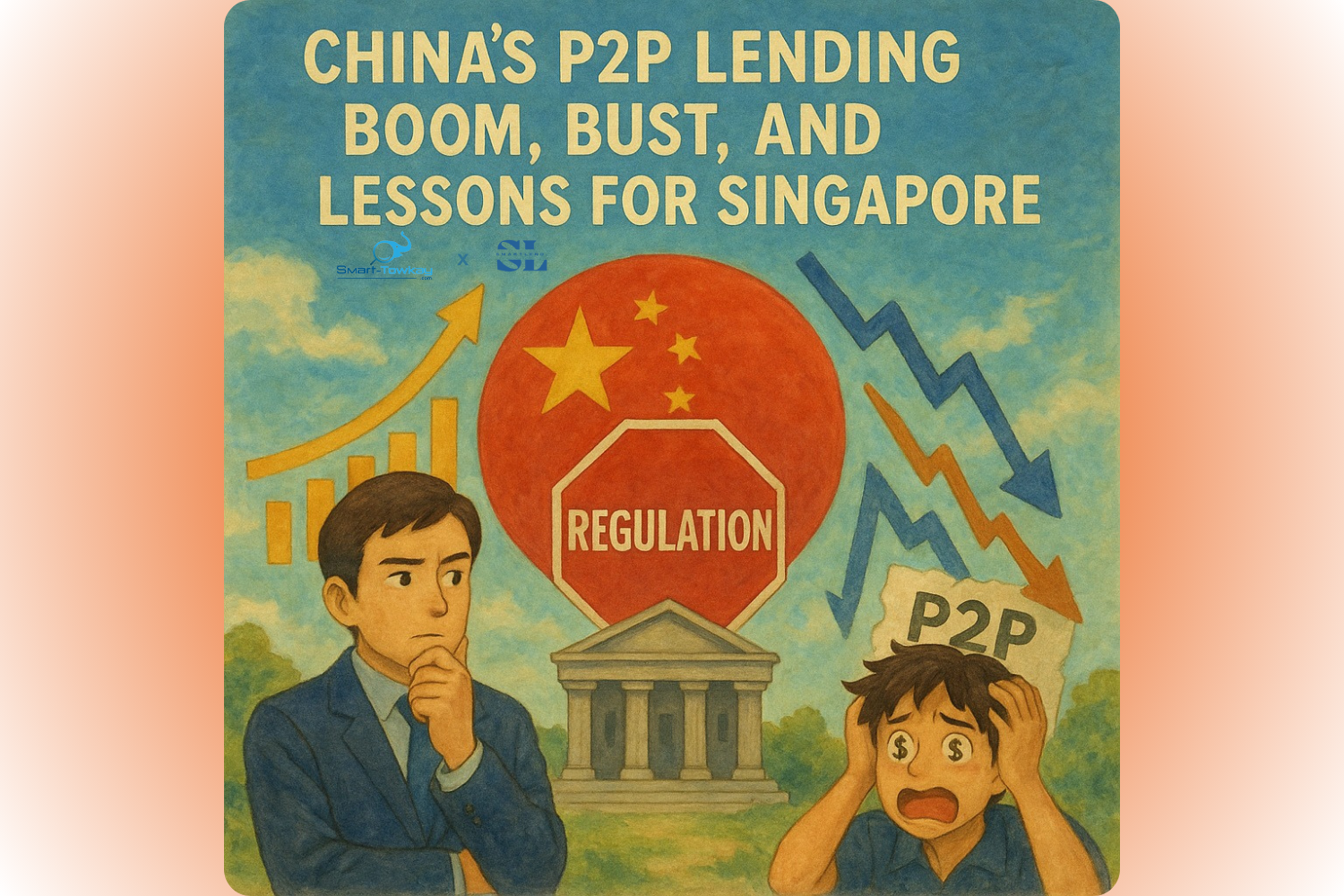
The Meteoric Rise of P2P Lending in China
By SmartLend Editorial | 8th Edition | September 2025
Peer-to-peer (P2P) lending – an online platform model directly connecting lenders with borrowers – took off explosively in China over the past decade. China’s first P2P lender, PaipaiDai (PPDAI), launched in 2007, marking the start of what would become the largest P2P lending market in the world. From around 2011 to 2015, the number of P2P platforms in China skyrocketed from only about 50 to nearly 3,500, far outpacing growth elsewhere. By the mid-2010s, Chinese P2P lenders were facilitating hundreds of billions in loans – with one estimate putting outstanding loans at roughly US$218 billion, larger than the rest of the world’s P2P market combined.
Why did P2P lending flourish so rapidly in China? Several factors converged to fuel the boom. First, millions of consumers and small businesses were starved of credit by traditional banks that preferred lending to large state-owned enterprises, leaving a huge financing gap that P2P platforms eagerly filled. Second, China’s tech-savvy population quickly embraced new fintech innovations (aided by the rise of mobile payments and e-commerce), making it easy for online lending to gain traction. And critically, in the early years there was minimal regulation – a Wild West environment in which platforms could launch and grow with little oversight. This regulatory vacuum encouraged fast innovation and aggressive expansion, as P2P startups offered investors attractive returns typically around 8–12% or more, far higher than bank deposit rates. With low interest rates on savings and limited investment options, mom-and-pop investors flocked to P2P sites in hopes of better yields, pouring money into loans to strangers on the internet.
By 2015, China’s P2P lending sector was by far the world’s largest. Some 5,000–6,000 platforms had sprung up (sources vary; one count shows ~3,500 active that year, while regulators later tallied over 6,000 in total at the peak). Monthly transaction volumes exceeded ¥130 billion (~S$26 billion) by early 2016. It seemed a new era of fintech-enabled “inclusive finance” was underway, extending credit to underserved individuals and entrepreneurs across China. However, the breakneck growth was outpacing the ability of authorities to monitor the industry. Beneath the optimistic narrative, serious cracks were forming.
Frenzy, Fraud and the Great P2P Crash
As money flooded into P2P lending, scams and risky practices proliferated. By 2016, China’s banking regulator found that roughly 40% of P2P platforms were essentially Ponzi schemes – using new investors’ funds to pay off older investors. Many platforms promised guaranteed high returns or falsely claimed safe “wealth-management” products, masking the fact that they were funding high-risk loans or outright frauds. Misallocation of funds, fake projects, and “runaway” founders (absconding with investor money) became distressingly common.
The most infamous case was Ezubao (e租宝), once one of China’s largest P2P sites. Ezubao turned out to be a massive Ponzi scheme, collecting about ¥59.8 billion (S$12+ billion) from more than 900,000 investors in just 18 months. The platform enticed victims with promises of 9–15% returns on fictitious projects; in reality, 95% of the listed investment projects were fake. When Ezubao collapsed in late 2015, authorities discovered it had failed to repay ¥38 billion owed to investors. In the aftermath, the scheme’s architect was sentenced to life in prison and 26 others were jailed – marking one of the biggest financial frauds in modern Chinese history. The Ezubao scandal was a watershed moment that underscored how dangerous the freewheeling P2P mania had become, wiping out the life savings of hundreds of thousands and sparking public outrage.
Nearly a million Chinese investors were scammed by Ezubao, a P2P lending Ponzi scheme that amassed about ¥50–60 billion before collapsing in 2015. The case shocked the nation and prompted a severe regulatory response.
Ezubao was not an isolated case. Scandals and failures spread like wildfire as the industry reached a frenzy. In mid-2018, a wave of P2P platform implosions sent shockwaves through China’s financial centers. Investors suddenly began pulling funds en masse as rumors of default surfaced. By official counts, at least 243 P2P companies collapsed in just June and July 2018, triggering panic withdrawals across the sector. What had been tenable for many platforms unraveled when liquidity dried up – some owners simply vanished overnight, and others froze payouts. Desperate investors took to the streets: in Shanghai, hundreds of people who had invested in a platform called PPMiao swarmed its shareholder’s office, demanding their money back. Similar protests by angry, defrauded investors erupted in cities around China, in some cases requiring police intervention. Media recounted heartbreaking stories of individuals who lost their life savings – for example, a single mother who lost ¥3.8 million (over S$750k) lamented “It’s finished, all finished.” The social unrest and grief stemming from P2P failures put enormous pressure on authorities to act decisively.
Beijing Brings the Hammer Down: Regulatory Clampdown in China
Caught off guard by the P2P explosion, Chinese regulators initially played catch-up. For years, oversight was lax – the prevailing approach was “wait-and-see” to allow fintech innovation, with the People’s Bank of China and Banking Regulatory Commission only issuing modest guidelines by 2015. Crucially, in 2015 they pushed responsibility for supervising P2P to provincial and local authorities, who often lacked the expertise and manpower to rein in thousands of new platforms. Many local regulators were overwhelmed – some districts had zero staff dedicated to monitoring P2P, and others simply froze in confusion without clear standards. This fragmented oversight proved ineffective, allowing dubious lenders to slip through the cracks until crises emerged. “An industry that should have been regulated more was not, and now we’re seeing it implode,” one fintech consultant observed in 2019.
After the Ezubao scandal in early 2016, Beijing realized stronger action was imperative. Regulators swiftly issued Interim Measures in August 2016 – China’s first comprehensive P2P lending rules. These banned platforms from taking public deposits or providing guarantees, insisting P2P companies serve strictly as information intermediaries (matchmakers) rather than de facto banks. Platforms were forbidden from pooling investor funds or lending off their own balance sheets, practices that had enabled Ponzi schemes and reckless lending. The new rules also introduced caps on loan sizes and required P2P firms to use custodian banks to hold client funds, aiming to prevent misappropriation. In late 2017, regulators further demanded that all P2P lenders register with local financial authorities by June 2018 and meet new compliance criteria. This “rectification campaign” set a clear deadline to weed out non-compliant players.
The regulatory net tightening had dramatic consequences. Hundreds of platforms shut down voluntarily or were forced out of business for failing to meet the new requirements (over 900 P2P companies closed by end-2016 alone as the first rules took effect). Those that survived faced heightened scrutiny. By mid-2018, when the registration deadline passed, many platforms still hadn’t completed required fixes – and a wave of enforcement followed, coinciding with the mid-2018 crash. The government’s tone shifted from mere “rectification” to an outright crackdown on the sector’s excesses.
Finally, in late 2019, Chinese authorities effectively pulled the plug on P2P lending as an industry. In November 2019, a special government task force announced that all remaining P2P platforms must wind down or transform within two years. Firms were ordered to stop taking new business, resolve outstanding loans, and convert into small loan providers (with hefty capital requirements) or else exit the market entirely. This edict was the death knell for the once-booming sector.
Tellingly, by October 2019 only 427 P2P lenders were still operating, down from about 6,000 at the 2015 peak. In other words, well over 90% of platforms had been eliminated through bankruptcy, consolidation or bans. The crackdown aimed to “reduce the loss of creditors, maintain social stability and prompt orderly development of finance.” The message was clear: preventing fraud and systemic risk trumped short-term fintech growth. Even some of the biggest players conceded defeat – for instance, Ping An’s Lufax, once a P2P leader valued at billions, announced it would exit P2P entirely amid the regulatory onslaught.
Shockwaves: Impact on Investors, Borrowers and Fintech Firms
The rapid implosion of China’s P2P lending left a trail of financial pain and lessons learned. Millions of retail investors collectively lost tens of billions of yuan. Some who had entrusted their life savings to P2P platforms saw their money vanish overnight. The investor backlash was intense – beyond protests, there were reports of depression, even suicides, among those ruined by fraudulent lenders (a stark human cost of inadequate regulation). The government, fearing unrest, even intervened to quell organized protests by victims at one point, underscoring the social volatility created by the crisis. Trust in online finance was badly shaken.
Legitimate borrowers, on the other hand, suddenly found an entire source of credit drying up. Small businesses and individuals who had relied on P2P loans now had to turn back to traditional banks (which often underserve small borrowers) or more expensive informal lenders. In the short term, this credit crunch hurt some entrepreneurs who no longer had easy financing. In the long run, authorities hope that more regulated channels (like licensed microlenders and banks) will fill the gap in a safer manner.
For China’s fintech companies, the P2P crackdown was existential. Thousands of P2P startups folded. Even well-known platforms pivoted their business models – many reinvented themselves as consumer finance companies, wealth management platforms, or small loan providers under stricter licenses. The few firms that navigated the transition successfully did so by embracing compliance and sometimes backing from big financial institutions. Overall, the episode reinforced that fintech innovators in China operate at the pleasure of regulators: a business built in a gray area can be wiped out when the pendulum swings toward tighter control. The P2P saga became a cautionary tale in China’s broader financial reform – illustrating the delicate balance between encouraging innovation and containing risks.
Singapore’s P2P Lending Landscape: A Study in Contrast
Across the sea in Singapore, P2P lending has emerged on a much smaller and more cautiously regulated scale, almost the mirror opposite of China’s trajectory. Singapore did not experience a wild P2P boom – instead, the industry here has grown gradually under the close watch of the Monetary Authority of Singapore (MAS). In Singapore, P2P lending platforms have always required regulatory approval and licensing before they can operate and solicit investors. MAS treats lending-based crowdfunding as dealing in securities (debentures), which means offers to the public are subject to the Securities and Futures Act. In practice, this means a P2P platform in Singapore must either register a prospectus for its loans or rely on private placement exemptions (for example, only targeting accredited investors or limiting the investor count). This framework sharply restricts mass retail participation in P2P deals unless rigorous disclosures are in place, preventing the kind of free-for-all seen in China.
Furthermore, any platform facilitating P2P loans must hold a Capital Markets Services (CMS) license from MAS. Notably, MAS requires P2P platforms to act purely as intermediaries – they cannot pool funds or lend on their own account, and investor monies are handled through escrow or trust accounts with approved banks. These safeguards mean that in Singapore, it would be extremely difficult for a P2P operator to run a Ponzi scheme or disappear with investors’ cash – the structural loopholes that plagued China’s market are essentially closed.
Singapore’s approach has been proactive and preventative. By 2016, as China was reeling from scandals, MAS had already granted full CMS licenses to local P2P pioneers like MoolahSense and Funding Societies, officially bringing them under the regulatory fold. MoolahSense, for instance, received its CMS license in Nov 2016 after a period in the MAS fintech sandbox, becoming the first licensed P2P lender in Singapore. From the outset, these platforms have operated with transparency – publishing risk disclosures, vetting borrowers rigorously, and reporting to MAS. Most Singapore P2P lenders focus on business financing for SMEs rather than consumer personal loans, which also reduces the risk of overleveraged individuals and aligns with Singapore’s goal of supporting small enterprises. For example, a typical Singapore platform might help fund a restaurant’s expansion or an invoice for a local startup, with investors pitching in small amounts per loan. The investor profiles also differ: Singapore restricts how P2P loans can be advertised and often encourages participation from accredited or institutional investors for larger deals. This ensures that those taking the risk are better equipped to understand it, and it caps widespread public exposure.
In sum, China’s rise and fall in P2P lending is a dramatic case study of fintech innovation outpacing regulation, and the painful correction that followed. Singapore’s more measured path has avoided the extremes, but it cannot be complacent. By heeding these lessons – enforcing robust standards, educating investors, and maintaining a proactive regulatory stance – Singapore can enjoy the benefits of fintech lending while avoiding the worst of the pitfalls.
📊 SmartLend Approval Stats (Weekly Update)
🚀 Week 8 Highlights
🔓 Launched eight weeks ago:
💼 SMEs Funded: 8
👤 Individual Funded: 4
💰 Total Disbursed: $880,125
⏱ Fastest Approval: 1 Day
📈 Top Loan Type: Bank Loan
🏪 Top Industry: E-Commerce
This post was adapted from our weekly SmartLend newsletter. If you’d like the latest tips, case studies, and SME financing insights delivered straight to your mailbox—join our newsletter here.